Case Study: IQ Endoscopes
Website case study
IQ Endoscopes: A MedTech Website Built Around Clinical Need, Product Clarity and Scalable Adoption
IQ Endoscopes is developing single-use flexible endoscopy technology for gastrointestinal procedures. The website has a demanding job: explain a clinically important problem, introduce a new technology platform, build confidence with healthcare decision-makers, and guide visitors towards product understanding or contact.
This case study looks at how the site brings together clinical need, product detail, use cases, sustainability and organisational credibility without turning a complex medical technology story into a dense technical brochure.

IQ Endoscopes website
IQ Endoscopes
Medical technology, GI endoscopy and healthcare innovation
Clinicians, healthcare providers, service leaders, investors and partners
Explain the need, prove the technology and generate informed enquiries
The organisation
IQ Endoscopes presents itself as a team of clinical, MedTech and engineering specialists working to improve access to safe, sterile endoscopy. The company traces its origin to founder Dr Patrick Ward-Booth, whose long experience in endoscopy shaped the idea that single-use endoscopy could help address a global service challenge.
The website positions the business around a clear clinical vision: a world where no patient waits unnecessarily for a life-changing diagnosis. That message matters because the site is not simply selling a device. It is presenting a case for changing how endoscopy capacity can be delivered.

The website challenge
A medical technology website has to serve several audiences at once. Clinicians need to understand whether the technology fits clinical workflows. Service leaders need to see how it could affect capacity, cost, deployment and patient pathways. Investors and partners need confidence in the team, market need, regulatory progress and commercial logic.
For IQ Endoscopes, the site needs to make several ideas clear without overwhelming the visitor:
- The pressure on existing GI endoscopy capacity
- The limitations of reusable endoscopy in some clinical and operational settings
- The practical role of a single-use gastroscope and portable base unit
- The use cases where the platform can support existing services
- The sustainability argument, including time, carbon, water, energy and resource impact
- The credibility of the team, regulatory progress and funding journey
How the website explains the opportunity
Problem
The site starts with endoscopy access, GI disease burden and rising demand.
Platform
Product pages introduce the IQ Scope and Q Vision Base Unit as a connected system.
Adoption
Messaging focuses on familiar handling, plug-and-play deployment and clinical workflow fit.
Use Cases
Specific settings show where the technology can support capacity outside the main unit.
Action
Visitors are invited to get in touch, explore products and understand the need in more detail.
Challenge one: explaining a complex clinical problem simply
The site does not begin with technical specifications alone. It starts with the pressure behind the product: rising demand for GI endoscopy, the need for earlier diagnosis, and the limits of relying only on traditional reusable equipment and decontamination workflows.
This is the right order for a healthcare innovation website. The visitor first needs to understand why the technology matters. Product detail becomes more persuasive once the clinical and operational problem is clear.
The Need section gives the site a strong educational layer. It explains increasing demand, late diagnosis, capacity constraints and the consequences for patients and healthcare providers. This helps the website serve early-stage visitors who may not yet be comparing product specifications but are trying to understand the scale of the problem.
Challenge two: making the product feel adoptable
New medical technology can create hesitation if it feels unfamiliar, disruptive or difficult to deploy. IQ Endoscopes addresses this by repeatedly framing the system around practical adoption: plug-and-play deployment, familiar ergonomics, portability and use in a range of clinical settings.
The IQ Scope is described as designed to look and feel like a reusable endoscope, which helps reduce perceived training and workflow friction. The Q Vision Base Unit is positioned around Full HD imaging, image and video capture, integrated insufflation, portability and compatibility with standard report writing systems.
That combination is useful because it speaks to more than the clinical user. It also speaks to operational stakeholders who need to understand how the platform could fit into existing hospital infrastructure.
Product messages that support adoption
Familiar handling
Ergonomic messaging helps clinicians imagine using the device without a steep behaviour change.
Portable setup
The base unit and single-use model support deployment beyond the main endoscopy room.
Less reprocessing reliance
Removing decontamination from the device workflow supports faster and more flexible patient pathways.
Media capture
Image, video and reporting compatibility help connect the procedure to clinical documentation.
Challenge three: proving relevance across different clinical settings
The Use Cases section is one of the most important commercial parts of the site because it turns the technology from an abstract innovation into practical deployment scenarios.
IQ Endoscopes shows potential applications in rapid access diagnostic clinics, outpatient environments, inpatient bedside assessments, operating rooms and intensive care units. These examples help different stakeholders recognise their own pressure points, whether the issue is capacity, portability, room availability, urgent access or reducing burden on the main endoscopy unit.
This supports conversion because healthcare buyers rarely respond to a generic promise. They need to see where the technology fits, what problem it reduces, and why the use case is realistic.

Challenge four: balancing sustainability with clinical access
Sustainability is a sensitive topic for single-use medical devices, and the IQ Endoscopes website handles this by broadening the discussion beyond materials alone. The site frames sustainability around people, planet and prosperity, then connects the argument to decontamination resources, hospital capacity, patient pathways and carbon impact.
This is a stronger approach than treating sustainability as a simple claim. It acknowledges the concern and then explains the wider system context: reusable endoscope decontamination consumes chemicals, water and energy, while more efficient patient pathways can reduce delays, repeat visits and pressure on hospital resources.
The sustainability page also gives quantified carbon examples from an IQE-commissioned evaluation, including CO2 savings across specific use cases and reductions compared with current provision. For a MedTech buyer, that kind of context can help move the conversation from principle to evidence.
What works well
The website works because it gives visitors several routes into the same strategic story: endoscopy demand is rising, existing workflows are difficult to scale, and single-use technology may help services increase access in specific clinical settings.
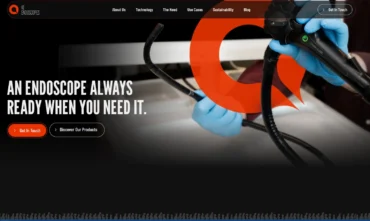
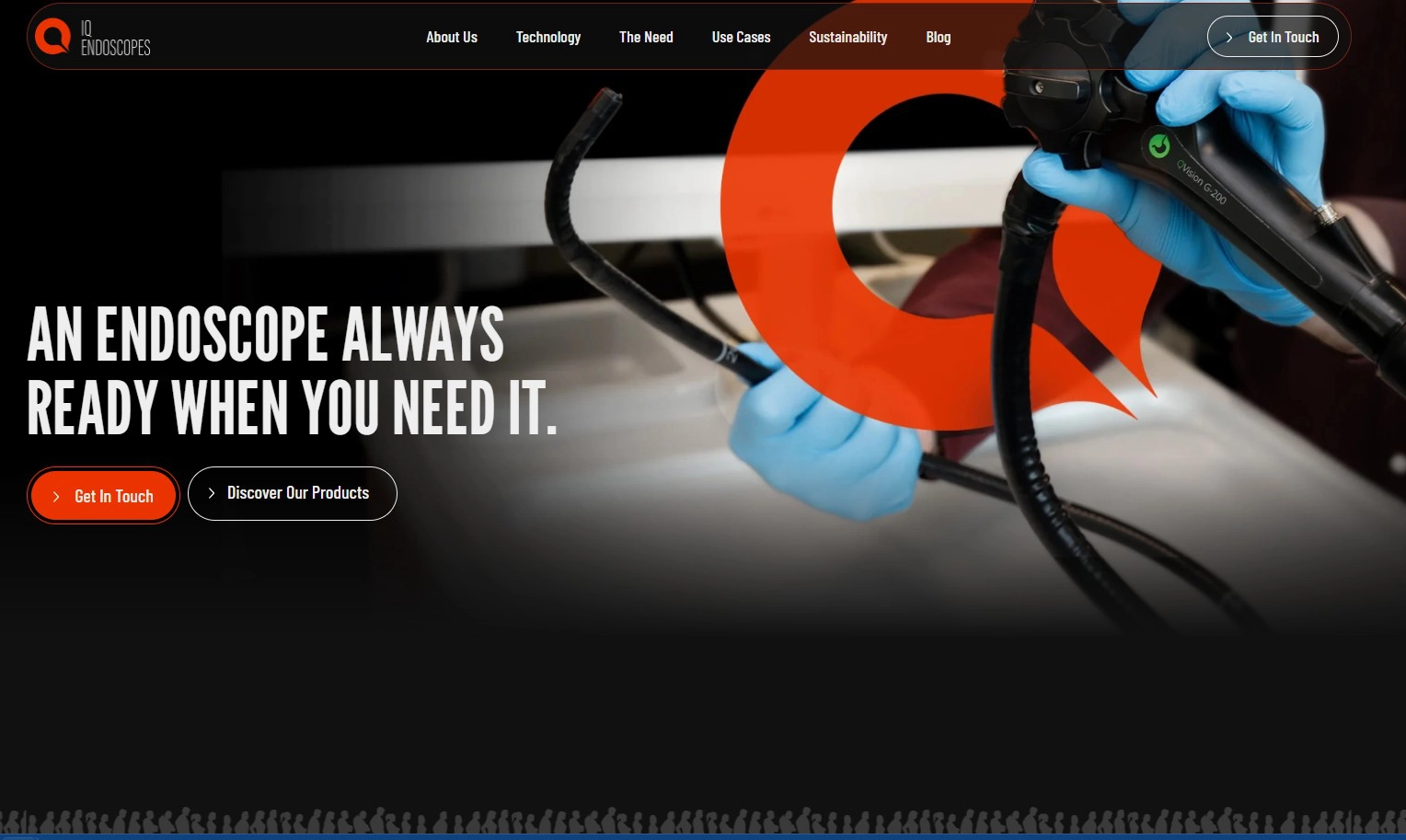
- The homepage quickly communicates the central promise: an endoscope ready when needed
- The Need section explains the clinical and operational pressure behind the product
- The Technology section separates the IQ Scope and Q Vision Base Unit clearly
- Use cases make the product easier to understand for different service settings
- Sustainability content addresses a likely objection rather than avoiding it
- The About page adds credibility through the leadership team, timeline, regulatory progress and funding history
- Product specification routes support visitors who are ready for deeper technical evaluation
Recommended next improvements
The site already has a strong foundation. The next gains should focus on turning high-interest visits into clearer enquiry paths and making each audience journey easier to measure.
- Create clearer audience routes for clinicians, service managers, procurement teams, investors and potential partners
- Add page-level calls to action that match intent, such as request product information, discuss a use case, download specifications or book a conversation
- Use internal links from The Need into relevant use cases, so problem-aware visitors can move towards practical applications
- Add short evidence-led FAQ sections to product and use-case pages covering adoption, workflow, decontamination, reporting, sustainability and clinical settings
- Track contact form submissions, product specification downloads, use-case clicks, video plays, email sign-ups and outbound social clicks
- Create more structured proof sections around regulatory progress, clinical design input, funding milestones and product development history
- Turn sustainability data into a clearer comparison module that can be reused across product, use-case and investor-facing pages
Summary
IQ Endoscopes has a website with a clear strategic role: help visitors understand why endoscopy capacity needs to change, how the technology works, and where it could support real clinical pathways.
The strongest part of the site is the way it connects product innovation to a wider healthcare problem. It does not rely only on device features. It explains demand, access, workflow, sustainability, use cases and organisational credibility as connected parts of the same story.
For future growth, the main opportunity is to make the conversion routes more specific for each audience. A clinician, service manager, procurement lead, investor and partner will all need different levels of proof before they enquire. The website can support that by linking each visitor from their concern to the most relevant product detail, use case, evidence and next action.
Need a clearer MedTech website journey?
If your website needs to explain a complex product, build trust with specialist buyers and generate better enquiries, Ace Web Studio can help improve the structure, content and conversion paths.
We focus on websites that connect content to business goals, so visitors can understand the offer, trust the organisation and take the next step.
- Clients:
IQ Endoscopes - Category:
Business - Date:
August 2025